Practical strategies to manage persistent pain
Meditation
Meditation for persistent pain is a structured, intentional mental practice that uses focused concentration or deep relaxation to alter how your brain processes long-term pain signals. Unlike broad moment-to-moment mindfulness, specific forms of traditional meditation use structured internal tools—such as guided imagery, rhythmic breathing, or repeated phrases—to systematically soothe an overactive nervous system.
How does it address persistent pain
Slowing the Stress-Pain Cycle: Persistent pain keeps your body in a constant state of “fight or flight,” which tightens muscles and naturally amplifies your physical discomfort. Meditation techniques signal the nervous system to relax, physically lowering your heart rate and easing the muscle tension that surrounds painful joints or nerves.
Redirecting Attention (Focused Concentration): By training your mind to focus entirely on a neutral object—such as a visualised calm landscape, a soothing warmth, or a specific phrase (mantra)—you actively quiet the brain regions responsible for monitoring and amplifying pain.
Reframing Pain Sensations: Many targeted pain meditations guide you to mentally break down a heavy sensation of “pain” into simpler, distinct physical properties (like heat, tingling, or pressure). This reduces the emotional alarm bells associated with the sensation, making it feel more manageable.
Common methods
Guided Imagery & Visualisation: Mentally painting a detailed, restful scene (like a quiet beach or a protective, cooling light over an aching joint) to give the mind a rich, positive alternative focus.
Deep Relaxation & Body Scans: Systematically directing a “wave” of physical relaxation from head to toe, explicitly inviting tense or guarded muscle groups to unlearn their protective clamping responses. See our relaxation section too.
Mantra or Focused Breath Meditation: Using a repeated word, reassuring affirmation, or the predictable rhythm of your breath as an anchor to draw your focus away from a pain flare-up.
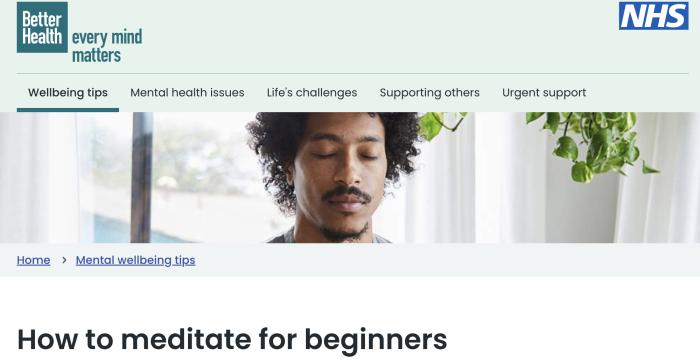
For an introduction and detailed guide, please click on the image below to access the NHS Better Health resource.