
Sciatica
Exercises for sciatic pain
The evidence is clear that exercise and activity is the best treatment for back and sciatic pains.
There is no set approach that has been shown to be the best so feel free to try different types of exercise and activity. Be guided by what you enjoy and what you feel able to start. Examples include cycling, swimming, lifting weights or going to an aqua-aerobics class.
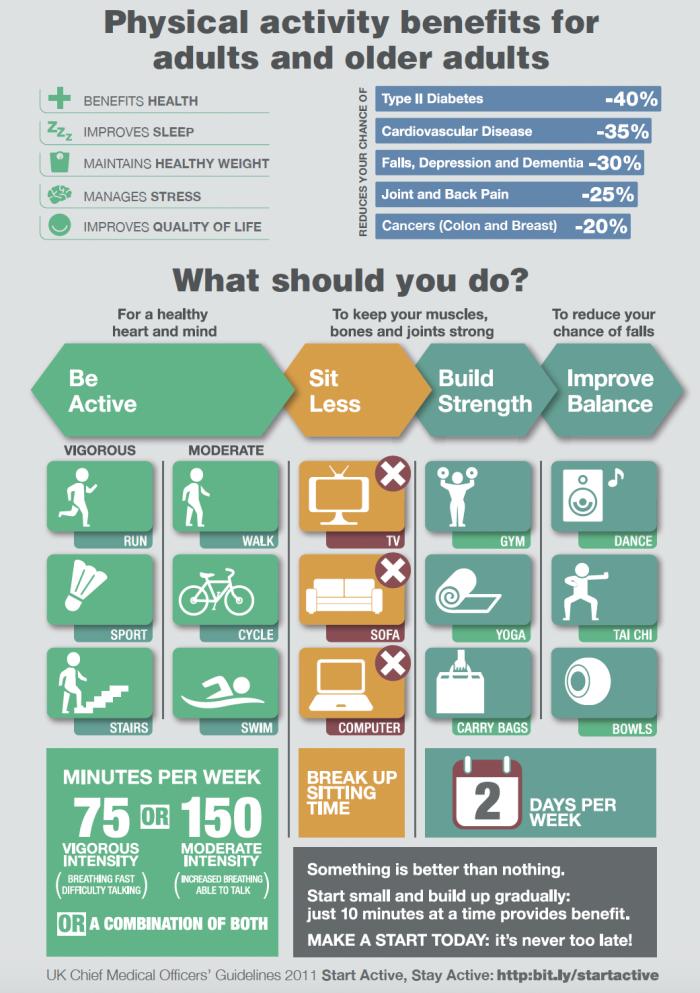
If you are local to Sheffield and you would like support to increase your physical activity, then you can:
- Self-refer to Move Well for personalised support and access to a wide range of physical activity opportunities, tailored to your specific needs and preferences.
- Want to learn more about Move Well? Watch a short video explaining what’s involved.
- To request a call from a Move Well Navigator, please complete a referral form.
- If you’d prefer to get started straight away, you can also use a free digital tool to find local physical activity opportunities. It provides details on locations, costs, and how to sign up.
Back and sciatic specific exercises
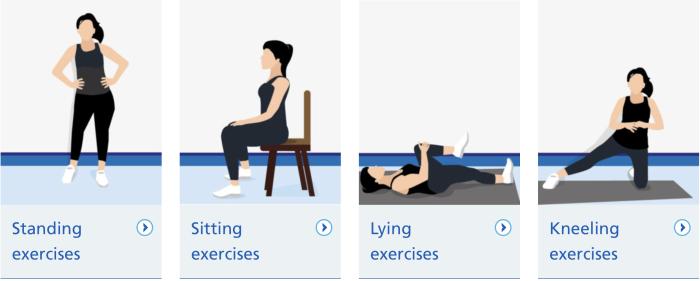

South Tees Hospitals have created a great online tool called BackTracks to help you build your own programme to help back pain. They have kindly shared this for all to use. These can be helpful for those with sciatica too. There are many to chose from. Many people will start with those in sitting or lying and do those that feel most achievable first.
If the exercise feels like it is easing the leg pain then it’s certainly one to stick with. If an exercise seems to be making more pain go down the leg then move on to a different one.
If you prefer to follow along with an exercise video, here are some options from an organisation called Arthritis UK. These exercises are helpful for many people with spinal pains (not just those with arthritis).
Please note though, the ‘straight leg raise’ exercise at minute 8-10 may well be a challenge for those with sciatica pains so feel free to skip that one.
Tailored stretching: Neck and back exercises (for arthritis and joint pain)
Printable version of video exercises in different languages
How many should I do and how often?
There is no set rule here. Be guided by how it feels.
Aim to do these exercises 2-3x daily if you can.
Make sure that you breathe throughout the exercise and focus on smooth, relaxed movement. By all means start with the directions/movements that feel the easiest to begin with.
You may only be able to manage a few to start with: that’s fine. Make a note of how many you can do and repeat this each day until it starts to feel easier. Gradually increase how many you practise over time (this can take several weeks).
What if the exercise is painful?
Exercising in pain is acceptable. It’s worth knowing that pain during exercise does not mean you’re harming yourself. As a general rule, if you experience pain at a manageable level, which settles within an hour and is not worse the next day, this is fine. However, if you experience more pain than you can comfortably tolerate and fails to settle within about an hour, you may want to scale the difficulty back next time. If this happens, don’t worry, you can try fewer repetitions and then gradually build it up again. If this still hasn’t helped, then seek professional help for further guidance.